
Understand TopsPay ACH Reversals
ACH Payment Failures and Reversals
ACH payments can fail for several reasons, including insufficient funds, non-transactional savings accounts, or incorrect account information.
When an ACH payment is posted to a patient’s ledger—whether as a one-time payment or through an automatic payment plan—it is initially assumed successful. Because ACH payments take several days to process, the payment is marked as deposited while the transaction is settling.
During this time, TopsPay pre-funds the payment so the practice is paid. Once the bank completes processing, the payment either remains a successful Charge or is updated to a Void status.
Patient Ledger
If an ACH payment fails, a reversal (clawback) occurs and posts to the patient ledger
- A TopsPay Reversal appears as a separate ledger line item
- The reversed amount is automatically added back to the patient ledger in Tops
- The original ACH payment remains visible with a deposited checkmark
-
Ledger notes reference both the original transaction date and the reversal date
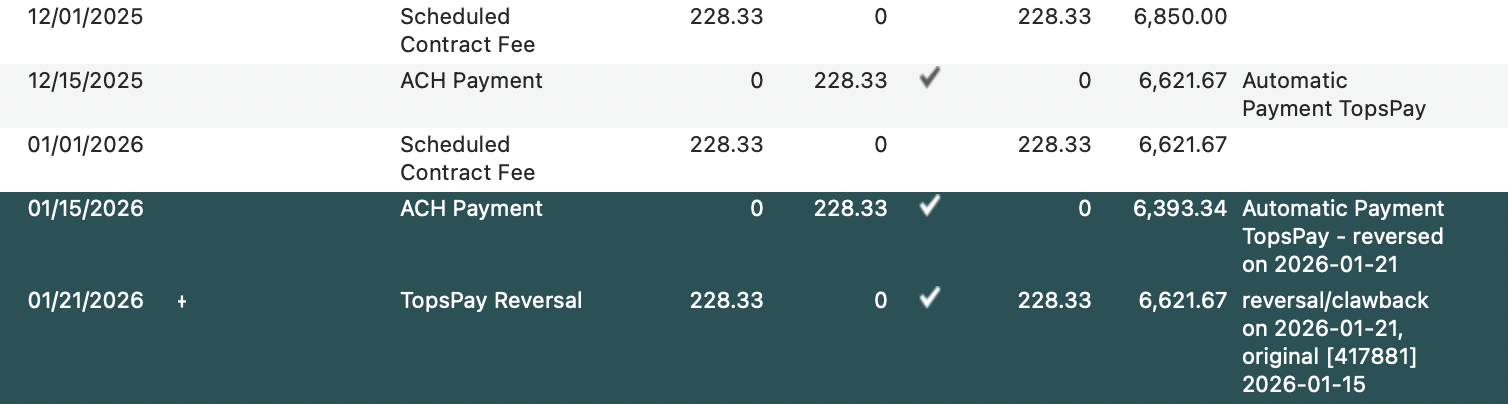
If the ACH payment does not reflect a checkmark indicating a deposit, and there is a corresponding TopsPay Reversal present, please contact Tops Support and reference the article at the bottom of this page where ACH payments still appear as undeposited.
Patient Auto-Pay Plan
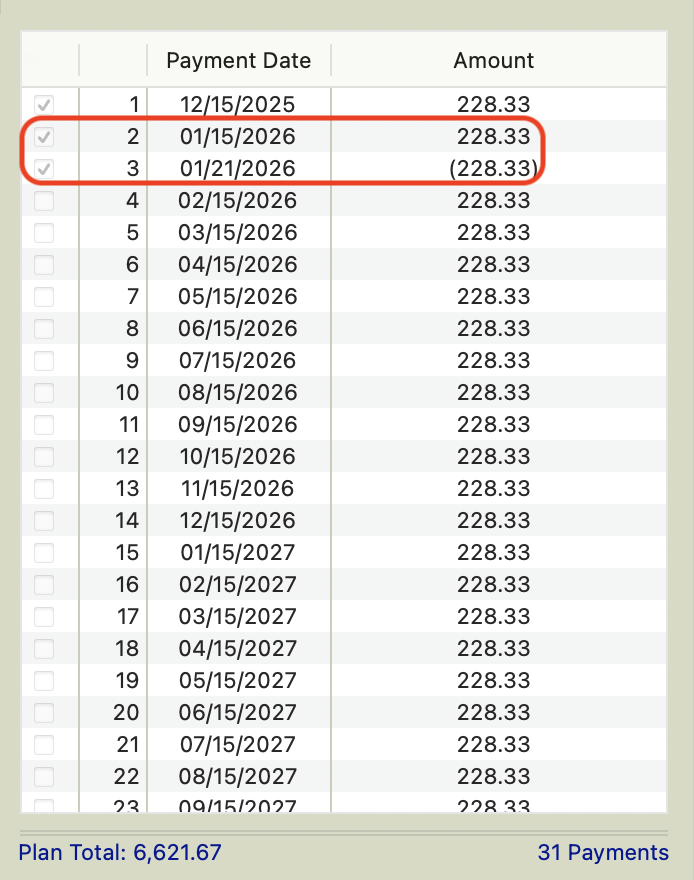
TopsPay reversals will be indicated in parenthesis on the ACH Auto-Pay plan.
Deposit Slip and Deposit Report
Each TopsPay reversal creates a new line item on the Deposit Slip in the Past Deposits filter and will also appear on the Deposit Report. The reversal amount will show in the withdrawn column.


Transaction Reports
The Financial Day Sheet and Transactions/AuditTrail will show TopsPay Reversal under the [+] Adjustment filter. Click and drag the [+] Adjustment column to the right to easily view the transaction amounts.

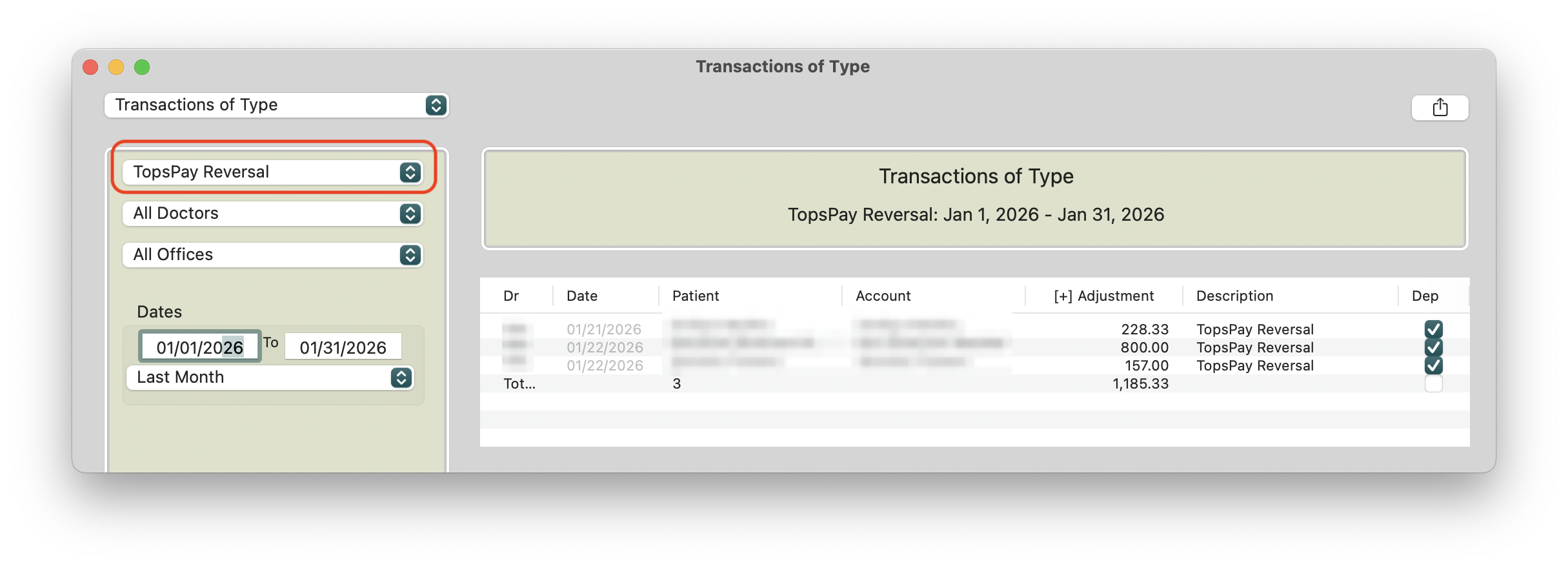
For a report of all TopsPay reversals you can go to Reports > Transactions of Type and use the TopsPay Reversal transaction type.
To easily see the amounts for each transaction, click and drag the [+] Adjustment column to the left as well as the Description column.
Review the Reason for the Reversal
When a TopsPay reversal occurs, it’s important to review the reversal details in the TopsPay portal to determine the cause. Common reasons include:
- Insufficient Funds
- Account Closed
- Non-Transactional Savings Account
- Invalid Account Information
- Other bank-related declines
Once you have identified the reason for the reversal, determine the appropriate next steps. This may include:
- Contacting the responsible party to discuss the failed payment.
- Updating the payment method or bank account information.
- Correcting the patient’s auto-pay plan.
- Temporarily deactivating the auto-pay plan until updated payment information is received.
- Determining whether an NSF (Non-Sufficient Funds) or administrative fee should be posted to the patient’s ledger to recover the fee incurred by the practice for the failed ACH transaction.
Leaving an auto-pay plan active without resolving the underlying issue may result in future scheduled payments failing as well. This can lead to additional TopsPay reversals, unnecessary fees, and delays in collecting the patient’s balance.
Best Practice: Review the reversal reason before taking action. Understanding whether the payment failed due to insufficient funds, a closed account, invalid account information, or another banking issue will help you determine the appropriate next steps, decide whether a fee assessed to the patient is warranted, and prevent repeated payment failures.