
Prepare for the Day
Get ready for your patient day by following these steps!
Confirm appointments and check lab work:
- Go to Matrix > Appointments.
- Enter the date/date range for which you are preparing and click Use Selected Date Range.
- Click the double arrows to display the drop-down menu and change the last three column headers to Lab Work, Phone Numbers and Confirmation. You can also sort columns by clicking on the column headers.

- If an appointment was marked as Should Confirm or Must Be Back From Lab, this will be displayed in the Appointment Matrix. The patient’s phone number will also be displayed so you can call and confirm. From the Appointment Matrix, double- click on the Appointment to open the information window. Call to confirm the appointment and check Confirmed after confirmation is complete. Or, after you have verified that the lab work is in the office, change the status to Back from Lab in the Appointment Information window.

Check Patient Balances:
- Go to Matrix > Appointments.
- Enter the date/date range for which you are preparing and click Use Selected Date Range.
- Click the double arrows to display the drop-down menu and change the last three column headers to Account A Financials, Account B Financials, and Phone Numbers.
- Note which patients have a Due Now, and under which account.

- Next, go to Reports > Appointments with Balances > 30 Days.
-
From the report window, select the date/date range for which you are preparing. Have the list accessible at the front desk. Columns from the report can be dragged in any order.
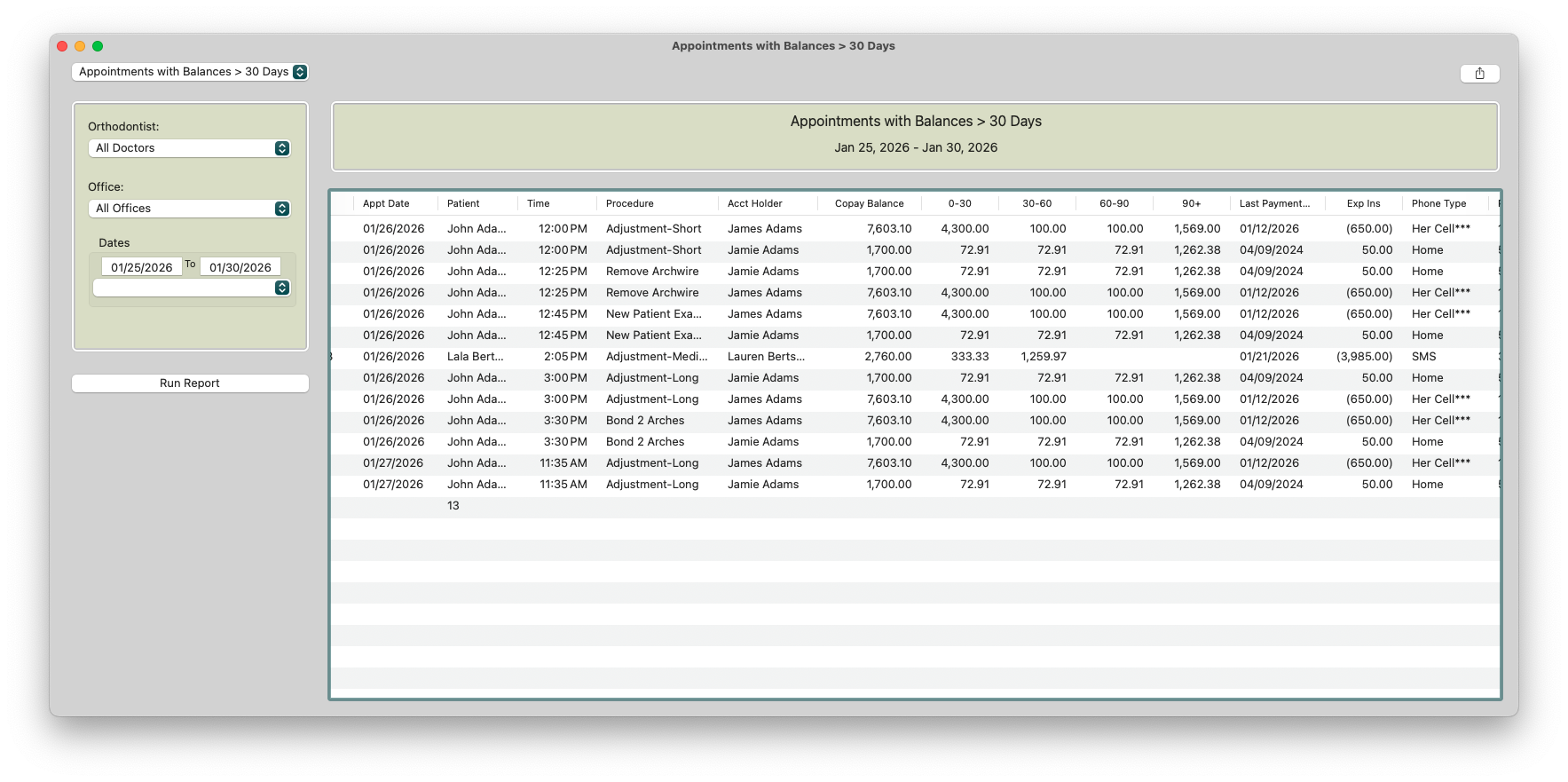
- To view each patient from the report, double-click on the patient’s name.
- When the Patient Information window opens, select the Appt/Recalls tab and double-click on the Appointment.
- From the Appointment Book, double-click the Appointment to open the Appointment Information window.
- Place a checkmark in the Requires Staff Attention checkbox. It may also be helpful to place an emojii 💰or financial note in the Grid notes for visual reference that a balance needs to be paid. When the patient checks in, they will receive a prompt to go to the front desk to discuss financials.
Prepare for Appointment Charges:
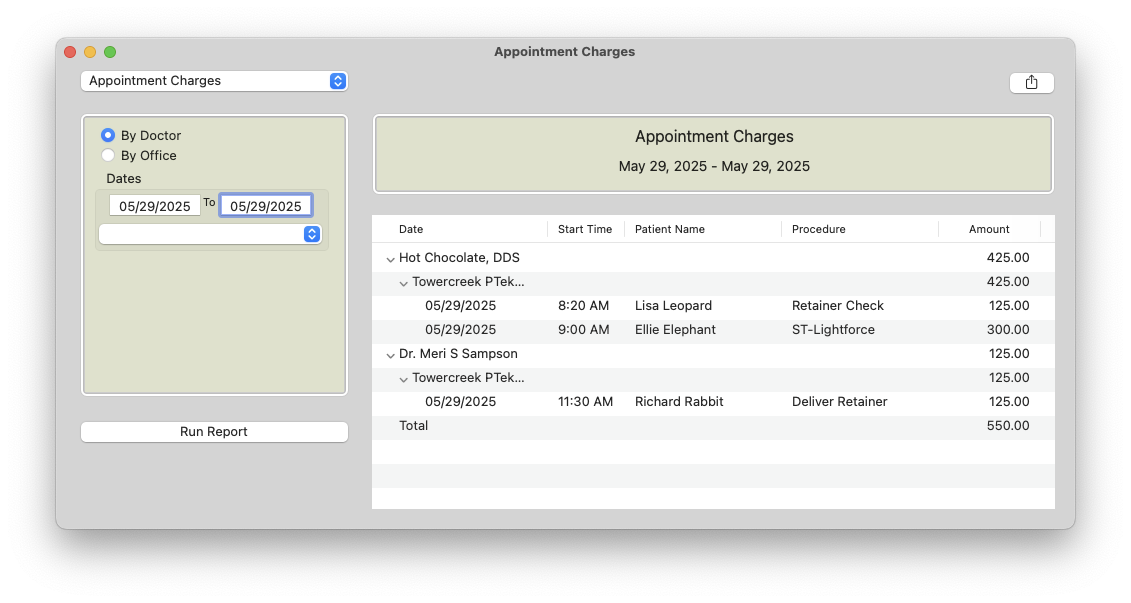
This report shows the possible appointment charges for the day.
- Go to Reports > Appointment Charges Today.
- From the report window, select the date/date range for which you are preparing.
- Use this report as a verification list when patients come for their appointments. Refer to this report to confirm all patients were charged for their appointments.
- Enter the expected charge for each Appointment Type in Tops Ortho > Practice Setup > Calendar > Appointment Types:

View the Next Visit Notes:
- Go to Matrix > Appointments.
- Enter the date/date range for which you are preparing and click Use Selected Date Range.
- Click the double arrows to display the drop-down menu and change the first column header to Next Visit Notes.
- Note: This feature is particularly helpful if you anticipate needing to see patients but will not be able to log into Tops Ortho the next day.

Review Recalls
One of the best ways to keep your schedule full is to review recalls each day. This helps ensure patients are contacted when they’re due for treatment and prevents patients from being overlooked.
Review Existing Recalls
- Navigate to Matrix > Recalls.
- Enter a date range (for example, one year ago through two weeks into the future).
- Customize the columns to display the information most helpful for contacting patients, such as:
- Procedure
- Phone Number
- Email Address
- Notes
- Review each recall to determine whether it still requires action.
- Double-click a recall to open the patient’s chart. From the patient’s chart, double-click the recall to update the recall date, notes, or other details as needed.
- Clear recalls that are no longer needed. For example:
- The patient has already scheduled the appointment, but the recall was not used to complete the scheduling process.
- The recall is a duplicate.
-
The recall was created in error.
To clear one or more recalls, highlight the recall(s), then select Edit > Clear.
Review Patients Without a Future Appointment or Recall
In addition to managing existing recalls, review patients who do not have a future appointment or an active recall. These patients are at the greatest risk of falling through the cracks.
Navigate to Report>Current Patients Without Appointment or Recall.
For each patient:
- Determine whether they should continue as an active patient.
- If treatment is complete or the patient will no longer be seen, update their status to Dismissed, enter a Dismissal Date, and select the Dismissed checkbox to archive the patient.
- If the patient should remain active, ensure they have either a future appointment scheduled or a recall created.
Tip: Every active patient should have a next step. They should either have:
- A future appointment scheduled.
- An active recall.
- A Dismissed status with the patient archived.
Following this workflow each day helps keep your recall list accurate, maintain a healthy patient pipeline, and ensure active patients don’t fall through the cracks.
Morning Office Readiness:
Before the office opens, prepare each workstation for the day.
- Each staff member should log in to Tops using their own unique password on the workstation they will be using throughout the day. Passwords should never be shared with other staff members.
- Open the Appointment Book and Patient Flow on each workstation so staff are ready to begin seeing patients as soon as the office opens.
- Remind staff to log out of Tops whenever they leave their workstation unattended. Logging out helps protect patient information and ensures all activity in Tops is accurately attributed to the logged-in user.
If your practice uses additional Tops services, create a daily checklist for those systems. For example:
- Respond to incoming text messages related to appointments.
- Review declined automatic payments and determine whether follow-up is needed.
- Review Matrix > Appointments for patients with appointment notes indicating they require a phone call before or after their visit. Set aside time during the day to contact those patients or coordinate with referring providers when necessary.
Tip: Spending just a few minutes reviewing these items each morning helps your team stay ahead of schedule changes, patient communication, and follow-up tasks before the day becomes busy.