
Add an Employer Policy
Tops Tip:
Before adding an Employer policy to a patient's chart or creating a new Employer Policy, search for the employer policy either using Command-Y or Matrix>Employer Policies to prevent duplicate policies from being created or from adding an incorrect policy to patient's chart.
Your patient is ready to start treatment and has provided you their insurance policy information. Below are examples and steps on how to add the employer policy to their Tops Ortho chart.
- Our example patient, Humberto, has a Tops Ortho chart.
- His father, Ignacio, is entered as his Account 1.
- Ignacio has an insurance policy through his employer, Walmart.

Add the Policy Holder
- Click on the Insurance 1 tab.
- Click on Choose Policy Holder.
- A Policy Holder search window will display. Search the name of the policy holder. If no results come up (and they shouldn't, unless the policy holder exists on the server from a past policy), click Create New Policy Holder.
IMPORTANT: If you see the policy holder's name come up in your search and they are showing connected to an old policy, DO NOT USE this. Create a new policy holder. This will mean that you will have the same person entered as multiple policy holders, and that's OKAY!
- You will see that Tops Ortho will automatically fill in the account holder information it has on file for the patient. If the Policy Holder is not the Account Holder, modify the Policy Holder details as needed.
- Enter the necessary information:
- ID number
- Assignment of benefit
- Policy Holder email
- Policy Holder date of birth
- Policy Holder payroll number (if applicable)
- Policy Holder gender
- The patient's relationship to the Policy Holder

Scenarios:
There are two possible scenarios for completing the Employer policy.
- The Employer Policy already exists in your Tops Ortho server.
- You need to add the Employer Policy to your Tops Ortho server for the first time.
Remember: Employer policies are shared by non-related patients.
- Unique details such as the patient's policy holder ID should NOT be entered into in the employer policy. It should live in the policy holder information.
- When you change any information in the employer policy, it changes the details for all patients who have or have had the policy in the past, and any claims that have been generated.
Scenario 1: If the Employer Policy already exists in your Tops Ortho server
After adding the Policy Holder information
- In the Employer policy section of Insurance 1, click the Employer... button
- An Employer Policy search window will display. Search the name of the employer policy.
- When the Employer Policy comes up in your search results, highlight it and click OK.
- The Employer Policy will now be linked to your Policy Holder!
❌Oops - Did you add the incorrect Employer policy?
If you add an incorrect Employer Policy to a Policy Holder, use the drop-down option next to the Employer Policy and select Change Employer Policy. Search and select the correct Employer policy. Make sure to update the Orig/Remaining Benefit section as changing an Employer policy will not update with the correct benefit amount.

Scenario 2: If the Employer Policy does not exist in your Tops Ortho server
After adding the Policy Holder information
- Click the Employer... button
- An Employer Policy search window will display. Search the name of the employer policy. If no results come up, click the Create New Employer Policy button from the search window.
- Enter the Employer Policy information. To learn more about the required fields, see related article below, Navigate the Employer Policy Fields.
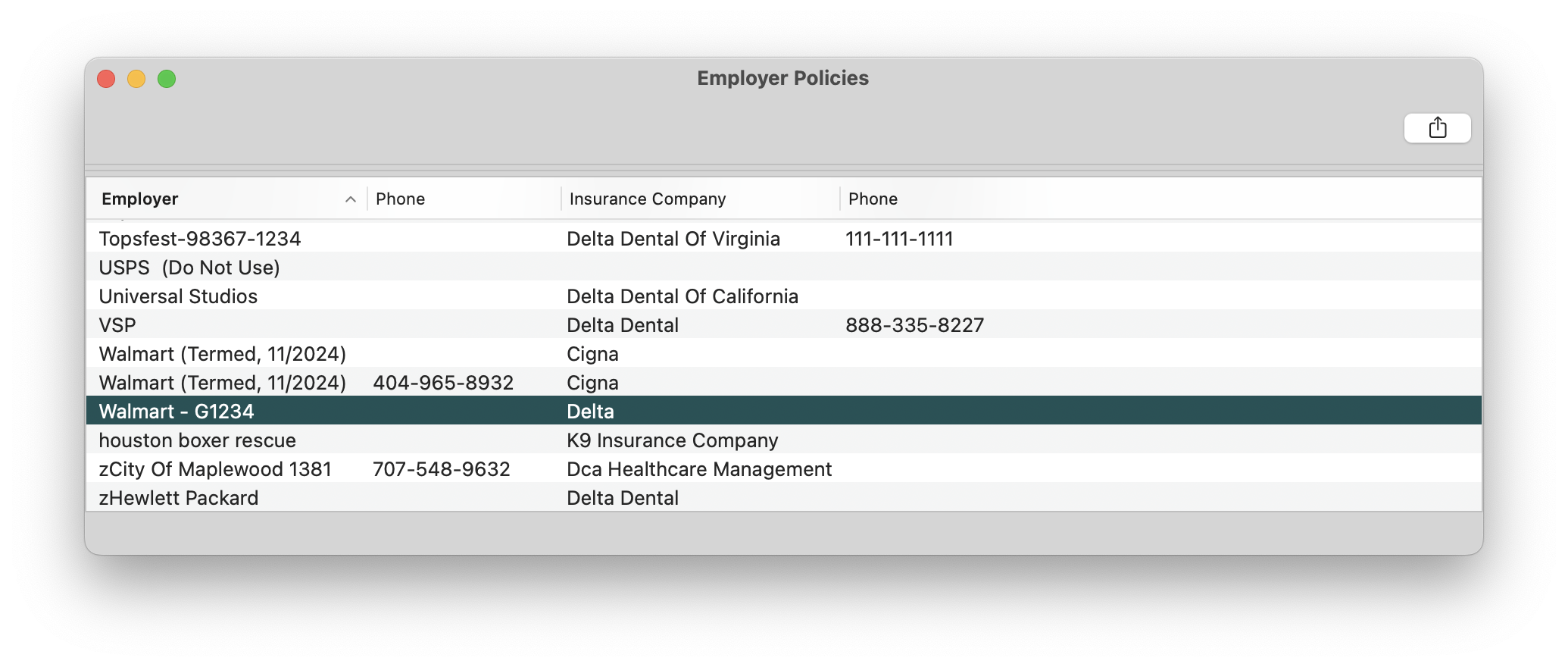
- To see all of the Employer Policies you have entered in your Tops Ortho server already, either use Command-Y or go to Matrix > Employer Policies. It is a good idea to check this before entering an employer policy to avoid duplicates! Policies can be searched by Employer Name and by Insurance.

❌Oops - Did you add an exact duplicate of an existing Employer Policy?
If you create a duplicate entry of an existing Employer Policy, triple check to make sure that it's a true duplicate.
- Some employer policies may have the same Group Number but vary in benefit, or may have the exact benefit, but may have a different Group Number.
If the Employer Policy created is a duplicate:
- Employer policies cannot be deleted once created.
- Do not delete the information from the policy.
- Rename the Employer Policy to help identify the record as a duplicate entry - i.e. (Walmart Duplicate Policy - Do Not Use). This will prevent the policy from being used again in the future.
- If you see a patient is listed with an Employer Policy, it means the policy is currently reflected in their chart.
- If you don't see a patient listed with an Employer Policy, it doesn't mean that a patient has not used the policy in the past. Previous patients that have used the policy in the past are connected historically through past claim information and their insurance ledger.
If you have not generated a claim or have not sent any claims from the duplicate policy:
- Change the Employer Policy to the correct version
- Use the drop-down option next to the Employer Policy and select Change Employer Policy.
- Search and select the correct Employer policy.
- Make sure to update or confirm the Orig/Remaining Benefit section is correct as changing an Employer policy will not update with the correct benefit amount.
- Void the patient's unsent claim, if applicable.
- Generate a new claim from Matrix>New Insurance Claim, if applicable.
Policy Holder and Employer Policy Relationships
What do you do when you need to change a patient's insurance or the patient no longer has insurance?
Read the article, Change an Employer Policy
In summary, think of the policy holder and employer policy relationship as a folder 📂
- To maintain the integrity of the contents of what's in the foler (claims 📃), you don't break the policy holder/employer policy relationship, even when the patient no longer carries that specific policy.
- Once you create a valid policy holder relationship with an employer policy, and generate claims, the details from both are tied to the generated claims, no matter if the claim is open, paid, closed or voided.
- This in mind, you will need to Change or Clear the policy Holder when a patient's insurance changes or has termed.

🍿 Watch a Quick Tip