
D7 Patient Care Tracking Report
The D7 Patient Care Tracking Report gives you a comprehensive view of your patients and practice activity, from initial contact and pending treatment through active treatment, retention, and dismissal. Use the D7 to see where patients are in the treatment process, identify patients who may need attention, and review key practice metrics such as case starts and finishes, treatment progress, visits, and value per visit.
The D7 is also a valuable tool for maintaining clean patient data. As you review your reports, you can identify missing or inaccurate information and jump directly to the patient’s chart to make updates.
Ready to dive in? Let’s take a look at how to navigate the D7, select the right reporting date, and understand the information it provides.
Make sure to reference the articles at the bottom of the page on getting your patients data ready for the D7!
Access and Choose a D7 Report
Go to Matrix > D7 Patient Care Tracking.
Select a report from the task menu to focus on a particular stage of patient care or type of activity.
Any D7 report can be filtered by Office Location, Treatment Coordinator (TC) or Doctor to help you narrow the results. We recommend engaging each filter regardless when opening the D7.
The default report is Status, Phase & Method. Open the task menu and scroll up or down to view the available reports. Choose the view that best matches the information you want to review.
|
|
|

Monitor/Observation
- Displays patients currently in a Monitor or Observation type of Treatment Status, helping you keep track of patients who are not ready for treatment but should continue to be monitored by your practice.
Pending Treatment
- Displays patients currently in a Pending type of Treatment status, such as patients who have not yet decided whether to move forward with treatment. Statuses include Will Call (Pending), Awaiting Specialist, Seeking 2nd Opinion, and Tx Suspended.
Pending Specialist Care
- Displays patients currently waiting for specialty care before proceeding with treatment, that reflect the Awaiting Specialist status. Use this report to keep track of patients who have been referred for additional care and need to return to your treatment process once that care is completed.
New Patients Entered
- Displays new patients entered into Tops during the selected date range.
All Without Scheduled Appt or Recall
- Displays patients who do not currently have a scheduled appointment or recall.
- This report can help identify current patients who may have fallen out of the normal scheduling workflow and need attention.
Case Starts
- Displays patients with a Case Start that falls within the selected date range.
Phase II Case Starts
- Displays patients with a Phase II Case Start that falls within the selected date range.
Comprehensive Case Starts
- Displays patients with a Comprehensive Case Start that falls within the selected date range.
Case Finishes
- Displays patients with a Case Finish (Tx End Date) that falls within the selected date range.
Exams
- Displays New Patient Exams that falls within the selected date range.
- For an appointment to be included in New Patient Exam reporting, the Appointment Type should be identified as Count as New Patient Exam.
No Show Exams
- Displays scheduled New Patient Exams that were missed during the selected date range.
No Shows
- Displays missed appointments during the selected date range.
Emergencies
- Displays appointments identified as Emergency Visits during the selected date range.
Active Treatment
- Displays patients in an Active Treatment treatment status as of the date selected.
- Keeping Treatment Statuses current is important. If a patient has started treatment but their Treatment Status hasn’t been updated appropriately, they may not appear with your Active Treatment patients.
Active Treatment in Multi-Specialty Care
- Displays Active Treatment patients who are specifically identified with a status as being in Multi-Specialty Care, as of the date selected.
Active Retention
- Displays patients currently in the Active Retention stage of care, as of the date selected.
Near Treatment Finish Zone
- Displays Active Treatment patients who are approaching their expected treatment completion window, as of the date selected.
- Patients in this category are within 3 months of their minimum estimated Treatment Length.
In Treatment Finish Zone
- Displays Active Treatment patients who are between their minimum and maximum estimated Treatment Length, as of the date selected.
- These patients are currently within their expected treatment completion window.
Extended Treatment
- Displays Active Treatment patients who have exceeded their maximum estimated Treatment Length, as of the date selected.
- This report can help you identify patients whose treatment has continued beyond the expected treatment window.
Too Many Retention Visits
- Displays patients who have had more than 3 Retention Visits, as of the date selected.
- For an appointment to be recognized as a Retention Visit, its Appointment Type should be identified as Count as Retention Visit.
Treatment Summaries
- Treatment Summaries provides an overview of your patients organized by Treatment Status, Treatment Phase, Treatment Method and with some, the Disposition.
Use these reports to see where patients are throughout your practice—from those who are pending or being monitored to patients who are actively receiving treatment, in retention, or have had their status updated to dismissed. Viewing patients from a Treatment Summary view can also help you identify patients who may be missing important information.

Additional views allow you to organize the same patient information differently, including:
- Phase, Method, Status
- Method, Phase, Status
- Status, Disposition, Phase, Method
- And other combinations
Select Your Reporting Date
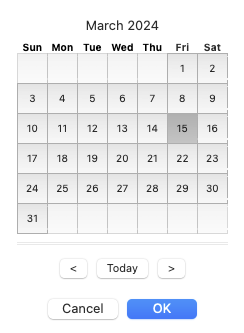
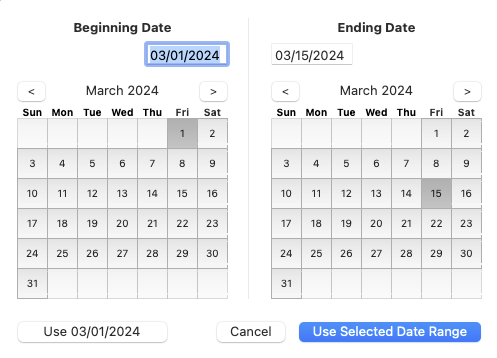
Depending on the D7 report selected, you’ll be prompted to choose either an "As of" date or a date range. The default date or date range is Month to Date.
Choose the task menu item you’d like to view. You’ll select the date or date range as indicated in the screenshots below:

|
|
Understand Your Reporting Date
You may have noticed that some D7 reports use a date range while others provide a snapshot as of a specific date. Understanding how D7 uses these dates is important when reviewing current or historical patient information.
The "As Of" Date
The D7 Patient Care Tracking reports are able to reflect information that existed in Tops as of the report’s As Of date.
Depending on the D7 report you are viewing, you may select a single date or a date range:
- As Of reports use the single date selected as the As Of date.
- Date range reports use the ending date of the selected range as the As Of date.
This is especially important when viewing D7 information for a past date. Information entered or changed after the report’s As Of date is not reflected, even when that information applies to an earlier date.
Example: Information Entered After the Fact
A patient started treatment on 2/1/2026, but the Treatment Start Date was not entered into Tops until 2/4/2026.
If you run Case Starts for 1/1/2026 through 2/1/2026, the patient will not be included. As of 2/1/2026, the Treatment Start Date had not yet been entered.
If you extend the report through 2/4/2026, the patient will be included with a Case Start of 2/1/2026. As of 2/4/2026, that information existed in the patient’s record.
Example: A New Treatment Phase or Plan
Suppose a patient finished a treatment case on 3/1/2026 and a new Treatment Phase and Plan was created on 8/12/2026.
If you run Case Finishes for 1/1/2026 through 9/30/2026, the patient will be included because their 3/1/2026 Case Finish falls within the selected date range. However, the patient details displayed will reflect the active Treatment Phase and Plan as of 9/30/2026, the ending date of the report.
To view the Phase and Plan details associated with the 3/1/2026 Case Finish, use an ending date before the new Phase and Plan was created. In this example, running the report through 8/11/2026 will display the earlier case information.
Keep in Mind - Whether you select a single As of date or a date range, the D7 reports information based on what existed in Tops as of the applicable As Of date. For date range reports , the ending date of the range serves as the As of date.
Understand D7 Visit and Value Calculations
The D7 tracks Tx Visits and Ex Visits for the patient’s Treatment Phase. Visit counting begins when a new Treatment Phase is created, allowing visit and value information to be associated with that phase of treatment.
| D7 Field | How It Is Calculated |
|---|---|
| Tx Visits | Counts completed Treatment Visits for the patient’s Treatment Phase through the selected As Of date. New Patient Exams, Records, Recall, Consult, Retention, and Emergency Visits are not counted as Tx Visits. |
| Ex Visits | Counts appointments identified as Emergency Visits for the patient’s Treatment Phase, regardless of how the appointment ends. |
| Total Visits | Tx Visits + Ex Visits when the treatment phase has at least one Ex visit. |
| Value per Tx Visit | Contract Amount ÷ Tx Visits when the treatment phase has an End Date. |
| Value per Total Visit | Contract Amount ÷ Total Visits when the treatment phase has an End Date and at least one Ex visit. |
Tx Visits + Ex Visits = Total Visits
Contract Amount ÷ Tx Visits = Value per Tx Visit
Contract Amount ÷ Total Visits = Value per Total Visit
How Emergency Visits Are Counted
Emergency Visits (Ex Visits)behave differently from regular Treatment Visits.
Once an appointment is identified as an Emergency Visit, it is counted as an Ex Visit regardless of how the appointment ends. This includes an Emergency appointment that is completed, cancelled, deleted, missed, or rescheduled.
Important: Rescheduling an Emergency appointment creates another counted Emergency Visit. For example, if an Emergency appointment is scheduled and then rescheduled to another time, even later the same day, the D7 will count 2 Ex Visits.
Because Ex Visits are included in Total Visits, this also affects the patient’s Total Visits and Value per Total Visit.
Navigate and Work With Your D7 Results
Pro tip: Use the Shortcut Command F to find a patient easy peasy!
Report Actions
| Engage each filter at least once to display all data |
|
| Drag Columns and order the data to your preference |
|
| Sort columns by their column header |
|
| Double-Click or Right-click on any patient listed to access their chart |
|
| Export any report to open in Excel or Numbers |
|
| Select multiple rows to easliy see selection averages at the bottom of the window |
|
| Column Headers with disclosure arrows have alternate views |
|


Reviewing Treatment Summaries
- From the list, click the disclosing triangles (on the left side of the list) to open up each level and display more information.
- To quickly open all levels in a group, hold down the option key and press the uppermost disclosing triangle. Click it again to close the levels.

- Missing Statuses are displayed at the top of the list in red.
- To filter the list by Doctor, Tx Coordinator, or Location, choose from the pop-up menu.

- To open a patient’s chart from the list, double click their name to jump directly to their Treatment Notes.
- You can also move directly to a specific area in the patient’s chart. Click the patient’s name to display a contextual menu and chose where you want to go.

- If you would like to reorganize the list, click the column headers to sort, or drag & drop columns. You can select a group of patients (click and drag along your selection) or select specific patients (hold the command key and click individual rows) to get totals and averages. There’s a lot to see and do in the D7 Matrix! Scroll to the right to see more columns.

Spend some time in D7 Patient Care Tracking! Go ahead and open up the various tasks, view all the columns, and play around. You’ll be surprised at how much information you can find. It will probably take a full patient cycle (weekly interval in which you see patients) for D7 Patient Care Tracking analytics to truly display your office’s statistics.
🍿 Watch a Video